For this Lupercalia, I wanted to centre the radical importance of shared knowledge and the ways in which access to knowledge shapes our political consciousness, our social values, and our capacity for resistance. History repeatedly shows us that the deliberate shielding of people from knowledge whether religious, sexual, or political is never neutral. It is a mechanism of control. And while knowledge can be destabilising or painful, it is also the means by which we refine our ethics, protect ourselves, and grow stronger as individuals and as communities.
What we are witnessing globally right now is staggering. Each time I turn on the news or encounter media tied to the rise of Christian nationalism, it feels increasingly surreal. These movements are not merely theological; they are explicitly political, seeking to legislate morality, restrict bodily autonomy, and reassert rigid hierarchies through religious authority. Against this backdrop, I wanted to revisit a foundational biblical narrative the story of Eve but to examine it unapologetically through a Satanic lens.
Last year, we explored Lilith. This year, I felt Eve deserved her moment. In the Genesis narrative, Eve is not a passive figure or a moral failure; she is the embodiment of ambition, appetite, and aesthetic discernment. She desires more than obedience. She hungers not just for sustenance, but for understanding. She recognises beauty and possibility in the forbidden fruit and makes an informed choice to pursue it. This alone destabilises the traditional reading. It is Eve who engages with the serpent, who accepts the gift of knowledge or more radically, the gift of moral awareness, humanity, and self-determination. As Genesis 3:5 states: “For God knows that when you eat from it your eyes will be opened, and you will be like God, knowing good from evil.” From a Satanic perspective, this is not a fall but an awakening: the rejection of imposed ignorance in favour of ethical autonomy. Eve’s “sin” is ambition her refusal to remain small. Her “crime” is appetite her willingness to want. Her transgression is aesthetic judgement her capacity to see, to desire, and to choose. The masculine seek to destroy or disallow the feminine to be those three things: women may not eat, they may not have ‘appetite’, this can be also be viewed as sexual appetite too. The aesthetic of a women is almost always through the a male gaze and ambition of women has always been suppressed, it’s embarrassing actually.
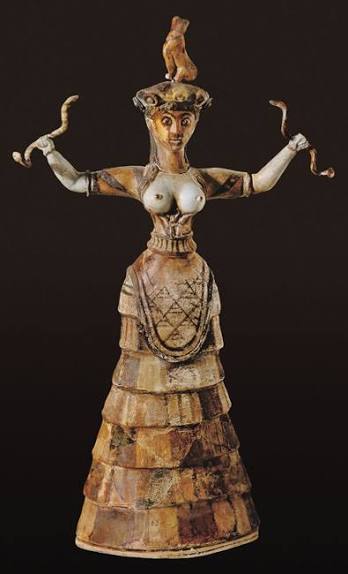
This story does not emerge in a vacuum. There is a deep historical association between feminine divinity and serpentine symbolism. Across ancient cultures, snakes were linked not only to danger but to wisdom, fertility, healing, and renewal. The Mesopotamian goddess Tiamat, the Hindu goddess Manasa, and the Minoan snake goddesses all embody this fusion of feminine power and serpentine knowledge. Scholars such as Marija Gimbutas and Elaine Pagels have argued that early biblical narratives often repurposed and inverted older pagan symbols, recasting sacred feminine figures as threats or temptations. Within this context, the serpent in Eden can be read as a distorted echo of earlier sacred iconography—its wisdom reframed as corruption, its beauty as deception.
From here, I wanted to draw a direct line to our discussion of Satanic sex previously shared privately within our Discord but not fully explored within the wider TST space. Lupercalia, after all, is fundamentally about self-empowerment: bodily autonomy, desire without shame, and consent as sacred. Appetite sexual, intellectual, and emotional is central here. Sex is not apolitical. It never has been. It is regulated precisely because it represents agency.
The demonisation of “sinful” sex has historically not produced virtue, but repression, hypocrisy, and exploitation. When desire is denied education and honesty, it does not disappear it becomes distorted. From a Satanic perspective, consent is not a footnote to sexuality; it is its ethical core. The condemnation of Eve mirrors the condemnation of feminine sexuality, queerness, and non-normative bodies: all are punished for wanting, for choosing, for refusing silence.
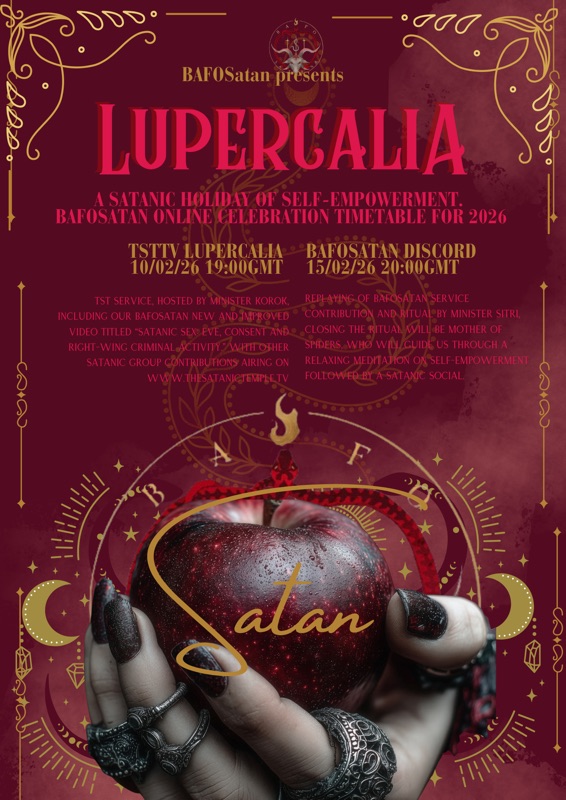
The service opens with my response to Karl Marx’s assertion that “religion is the opium of the masses.” My reply remains: if religion is the opiate of the masses, then Satanism is the rehab centre. From there, I examine our current political landscape and argue that the pursuit of knowledge is not optional it is essential. To resist Christian nationalism, we must identify our strengths, sharpen them, and apply them deliberately. Ignorance sustains authoritarianism; knowledge destabilises it.
I then move fully into the Satanic sex portion of the presentation, examining how sex becomes a political weapon, how repression fuels moral panic, and how Satanism reframes sexuality through autonomy, informed consent, and self-knowledge. The demonisation of the feminine and the queer is not incidental it is the same fear that condemns Eve: fear of ambition, appetite, and aesthetic self-direction.
I close with some deliberately bold statements. They are meant to provoke reflection rather than reassurance. I trust you will see the angle I am approaching this from and I hope it is received in the spirit in which it is offered.
Hail Satan,
Minister Sitri

Marvellous! 🖤🤘🏻💯
ReplyDeleteHi is there a link for the discord event on the 15th?
ReplyDeleteHey Jack! Give me an email on sitritommy.belucifer@thesatanictemple.org and we’ll take it from there 🙂
Delete